Location & Tracking Systems
GNSS-based tracking hardware with indoor fallback via Wi-Fi SSID positioning and BLE-LR — from 12×12 mm embeddable modules to M2M-connected field trackers.
Explore the ArchitectureArchitecture
A modern tracking system has to assume that satellites are sometimes invisible. Our architecture explicitly designs for that: a multi-constellation GNSS receiver chain at the core, with parallel Wi-Fi SSID scanning and BLE-LR ranging as drop-in fallbacks. A sensor-fusion layer reconciles the three streams into a single position-confidence estimate, so the application sees a coherent answer regardless of what the radio environment looks like at any given moment.
Power is the dominant design axis. A single AA-equivalent cell can drive a tracker for up to 6 months on hourly fixes.
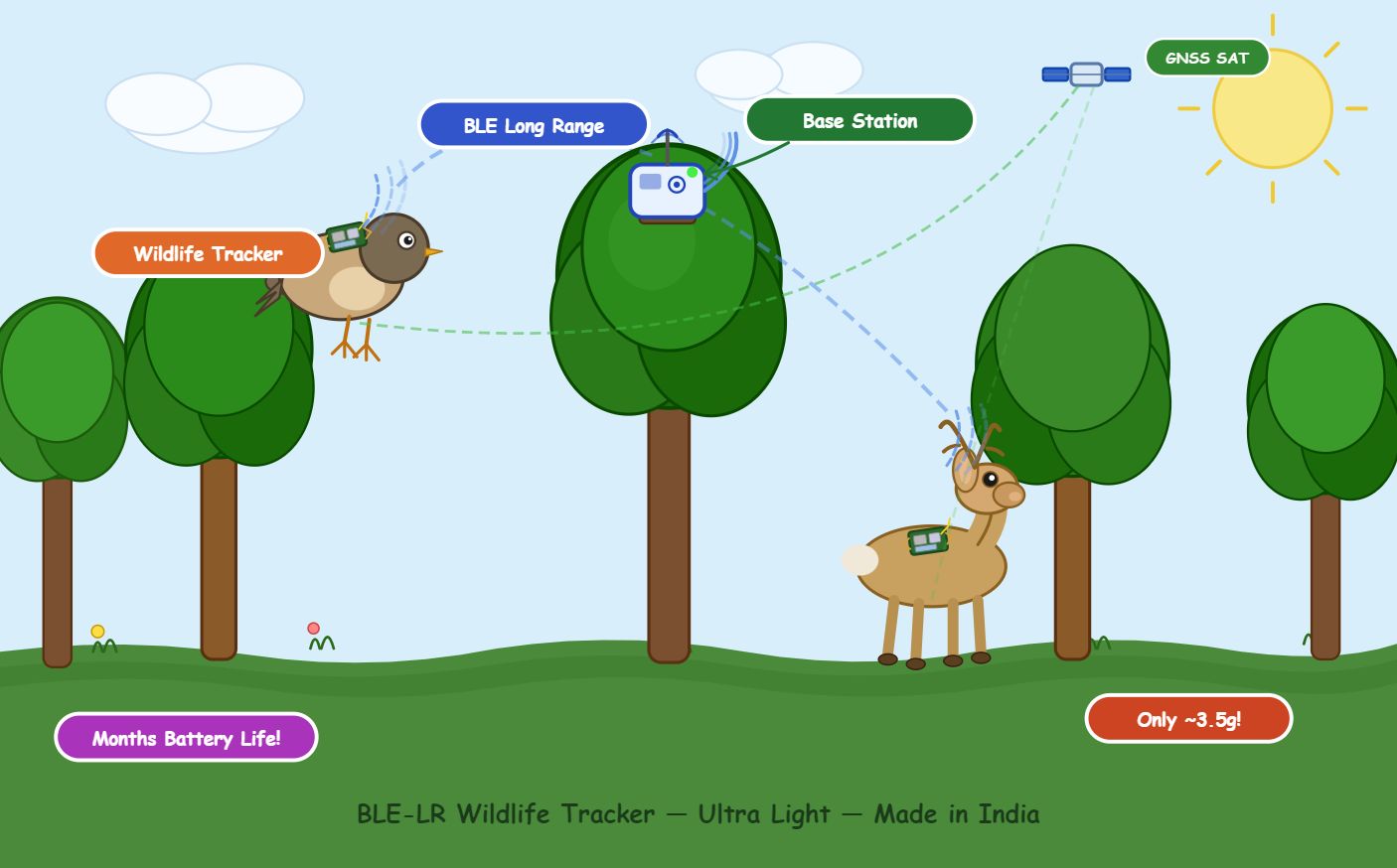
The connectivity path is split from the positioning module on purpose. The smallest configuration is a 12 × 12 mm module with no cellular at all, paired with a fixed BLE-LR gateway that uplinks on its behalf — a strictly better answer for campus-scale deployments.
Engineering Approach
We characterise GNSS performance against a Spirent simulator across a defined trajectory set: open sky, urban canyon, dense foliage, and indoor through a window. Field validation then confirms the bench performance with on-vehicle measurements over the Western Ghats and the Mumbai-Pune corridor — the two harshest mixes of multipath and dropout we have access to.
Antenna placement is decided alongside the mechanical design, not after. A patch antenna placed under a metal canopy is functionally a non-antenna; we have killed a lot of project time over the years insisting on this conversation early.
For indoor and dense-urban applications, we operate a database of Indian Wi-Fi SSID positions and ship anonymised observation uploads from deployed devices to keep that database fresh.
Standards & Compliance
GNSS conformance is to the constellation specifications, with IRNSS support relevant for the Indian-region application set. RF compliance follows ETSI EN 303 413 for GNSS receivers and the band-specific standards for the supplementary radios (BLE, Wi-Fi).
Privacy is governed by DPDP Act considerations on Indian deployments — location data is treated as personal data, with explicit consent flows and on-device anonymisation where the application allows.
Where this capability ships in the world.
Real products that exercise the location & tracking systems stack — click through for the full case study.
Other engineering disciplines at DSPWorks.
Railway Signalling Engineering
Trackside and control-room systems for signalling, interlocking, and train protection. Designed to RDSO and CENELEC standards for Indian Railways and metro networks.
Wireless Systems
Multi-protocol wireless hardware design across LoRa, BLE-LR, IEEE 802.15.4g sub-GHz, Wi-Fi, Thread, Matter, and 4G/LTE — tuned for range, power, and data.
Home Automation Systems
End-to-end home automation — device hardware, firmware, cloud backend and mobile app. 802.15.4g sub-GHz mesh, Wi-Fi, and Matter / Thread — supplied as OEM platforms.
Industrial, Agricultural & Utility IoT
Monitoring and control for pump sets, three-phase power, industrial switching, and utility metering (including retrofit gas AMR) over 4G, NB-IoT, or LoRa.
Ready to transform your complex challenges into competitive advantages?
Partner with DSPWorks for end-to-end product realization that combines technical mastery with global scale.